For anyone who enjoys the warmth of a crackling fire, a backyard bonfire, or the convenience of a wood-burning stove, creating kindling is an essential yet often cumbersome task. Traditional methods involving axes or hatchets can be dangerous, demanding precision and significant physical effort. This comprehensive review delves into the Kindling Cracker Firewood Splitter, examining how this innovative tool offers a safer, more efficient, and often more enjoyable way to prepare kindling and smaller firewood for your home or outdoor adventures. We’ll explore its design, performance, safety features, and how it stands up to the demands of everyday DIY use.
What is a Firewood Splitter? An Overview of the Tool
A firewood splitter is any device designed to cleave logs into smaller, more manageable pieces for burning. Historically, this task was performed manually with an axe, relying on brute force and technique. However, modern innovations have introduced various types of splitters to make the process easier, safer, and more efficient. The Kindling Cracker, a distinct type of manual firewood splitter, stands out for its unique approach to splitting wood. It consists of a robust cast-iron frame with an integrated splitting wedge and a safety ring, designed to be used with a blunt instrument like a hammer or mallet rather than a swinging axe. This fundamental design shift aims to minimize the risks associated with traditional wood splitting while providing a practical solution for producing kindling.
Detailed Classification of Firewood Splitters
Firewood splitters come in several forms, each suited to different volumes and types of wood, as well as varying user preferences. Understanding these categories helps contextualize where the Kindling Cracker fits into the broader landscape of wood-splitting tools.
By Energy Source
The power source dictates much about a splitter’s capabilities, portability, and environmental impact.
- Manual Firewood Splitters (e.g., Kindling Cracker): These splitters rely on human power, either through leverage, a striking action, or a hand-pumped hydraulic system. The Kindling Cracker falls into the striking category, utilizing a fixed wedge and external force.
- Pros: Extremely safe (no sharp blade swinging, hands kept away), virtually maintenance-free, durable, quiet, can be used indoors or outdoors, no fuel or electricity required, environmentally friendly.
- Cons: Requires physical effort, limited to smaller logs and kindling, slower for large volumes, not suitable for very large, dense, or knotty wood.
- Application: Ideal for home users, camping, small-scale kindling production, or anyone prioritizing safety and simplicity.
- Electric Firewood Splitters: Powered by an electric motor, these typically use hydraulic pressure to push a log against a wedge.
- Pros: Quieter than gas models, no exhaust fumes (can be used indoors), less maintenance than gas, generally more portable than gas, effective for light-to-moderate splitting tasks.
- Cons: Requires access to an electrical outlet, less powerful than most gas models, cycle times can be slow.
- Application: Suitable for homeowners with moderate wood-splitting needs, working near a power source.
- Gas Firewood Splitters: Featuring a gasoline engine, these are the most powerful and are often hydraulic.
- Pros: Highest splitting force, can handle very large and tough logs, completely portable (no power cord needed), faster cycle times for high-volume work.
- Cons: Noisy, produces exhaust fumes (outdoor use only), requires fuel and engine maintenance, heavier and less portable than electric or manual models, higher initial cost.
- Application: Best for heavy-duty, high-volume log splitting, processing large, dense wood in remote locations.
- Manual Hand Splitters (Wedges/Axes): While not “splitters” in the same fixed-tool sense, traditional axes and splitting wedges are the most basic manual method.
- Pros: Highly portable, low cost.
- Cons: Most physically demanding, highest risk of injury, technique-dependent, can be inefficient.
- Application: Occasional, light splitting, survival situations.
|
Our Picks for the Best Log Splitter in 2026
As an Amazon Associate I earn from qualifying purchases.
|
||
| Num | Product | Action |
|---|---|---|
| 1 | 13.8 Inch XL Manual Log Splitter with Self-Locking V-Blade for Hands-Free Safety - Unbreakable Welded Steel Firewood Cutter - Rust-Proof Electroplated Finish for Large Rounds, Fireplace & Camping |

|
| 2 | Firewood Kindling Splitter for Wood, Heavy Duty Cast Iron Wood Splitters for Firewood with No Axe, Manual Log Splitter for Kindling Wedge Point with Safety Cover |
|
| 3 | Kindling Cracker Firewood Kindling Splitter — Original Cast Iron Wood Splitting Wedge, 6.5" Safety Ring, 12" Frame, No Axe Needed, New Zealand Designed & Australian Made |
|
| 4 | 2 Pcs 4 Lbs Wood Splitting Wedges Manual Log Splitter Wedge 4-Direction Diamond Design Forged Steel Tool for Easy Wood Splitting Splits Firewood into 4 Pieces Less Effort (Orange) |
|
| 5 | Wall Mounted Wood Splitter: Dual-Handle Manual Kindling Splitter with 6-Tooth Clamping, Heavy Duty Steel Log Splitter for Soft Firewood, Includes Gloves and Screws for Indoor and Outdoor Use |
|
| 6 | Kindling Cracker King XL Firewood Kindling Splitter – Extra-Large Cast Iron Wood Splitting Wedge, 9" Safety Ring, 17" Height, No Axe Needed, Made in Australia |
|
| 7 | Wood Kindling Splitter - The Firewood Kindling Tool for Wood Stove Fireplace and Fire Pit |
|
| 8 | ESTWING Sure Split Wedge - 5-Pound Wood Splitting Tool with Forged Steel Construction & 1-7/8" Cutting Edge - E-5 |
|
| 9 | Firewood Kindling Splitter, Manual Log Splitter, Cast Iron Log Splitting Wedge, Heavy Duty Wood Splitter Tool with Cover (Black) |
|
| 10 | KABIN Kindle Quick Compact Log Splitter - Manual Splitting Tool - Steel Wedge Point Splits Firewood Like A Boss Safely & Easily |
|
By Size and Capacity
The dimensions and maximum log capacity of a splitter are critical for matching the tool to the wood you need to process.
- Small-Scale Firewood Splitters (e.g., Kindling Cracker): Designed for kindling and smaller logs, typically up to 9 inches in diameter.
- Advantages: Easy to use, relatively inexpensive (compared to powered models), perfect for starting fires efficiently, fits compact spaces.
- Disadvantages: Limited splitting capacity, not for primary log splitting, requires manual effort.
- Large-Scale (Industrial/Commercial) Splitters: These are powerful machines, usually gas-powered, capable of splitting large, dense logs, often exceeding 20 inches in diameter.
- Advantages: High output, handles toughest wood, built for continuous operation.
- Disadvantages: Very expensive, bulky, requires significant space, not for casual use.
By Splitting Direction
While more relevant for powered hydraulic splitters, splitting direction refers to how the ram pushes the log. The Kindling Cracker operates with a vertical splitting action as the log is driven downwards onto the fixed wedge.
- Horizontal Splitting: The log is placed horizontally and pushed through a wedge.
- Vertical Splitting: The log is placed vertically and the ram pushes down. This orientation is common for larger, heavier logs as it reduces the need to lift them.
Comparison Table: Kindling Cracker vs. Common Splitters
To illustrate the Kindling Cracker’s unique position, here’s a comparison with typical small electric and gas splitters.
| Feature | Kindling Cracker (Manual) | Small Electric Splitter (e.g., 5-7 ton) | Small Gas Splitter (e.g., 10-20 ton) |
|---|---|---|---|
| Energy Source | Manual (Hammer/Mallet) | Electric (120V outlet) | Gasoline Engine |
| Splitting Force | User-dependent (effective for kindling/small logs) | Moderate (5-7 tons) | High (10-20+ tons) |
| Max Log Diameter | 6.5″ (Original), 9″ (King) | Typically 10-12″ | Typically 12-20″ |
| Max Log Length | 12-19″ (depending on model) | Up to 20-22″ | Up to 24-25″ |
| Portability | Low (heavy cast iron, but no external power) | Medium (lighter than gas, but tethered to outlet) | Medium (heavy, but untethered) |
| Noise Level | Very Low (impact sound) | Low | High |
| Fumes/Emissions | None | None | Yes (outdoor use only) |
| Maintenance | Very Low (occasional sharpening/cleaning) | Low (check hydraulic fluid, seals) | High (engine maintenance, oil changes, fuel) |
| Safety | Extremely High (hands never near blade) | High (two-hand operation, safety guards) | Moderate (fast-moving parts, engine hazards) |
| Cost | Low to Medium | Medium | High |
| Ideal Use | Kindling, small logs for fireplaces, stoves, camping | Homeowners, moderate wood use, working near power | Heavy-duty home use, larger logs, remote splitting |
How to Choose the Right Firewood Splitter for You
Selecting the best firewood splitter, especially when considering a specialized tool like the Kindling Cracker, involves a careful assessment of your needs and priorities.
Determining Your Usage Needs
Start by evaluating the specifics of your wood-splitting tasks.
- Volume of Wood: How much wood do you split regularly? For small batches of kindling or occasional fire pit use, a Kindling Cracker is highly efficient. For cords of firewood, a powered splitter would be more suitable.
- Size and Type of Wood: The Kindling Cracker excels with logs up to 9 inches in diameter, especially dry, straight-grained wood like pine, birch, and even oak. If you routinely deal with larger, wetter, or extremely knotty hardwoods, you might need a more powerful tool.
- Budget: Manual splitters are significantly more affordable than electric or gas models, making the Kindling Cracker an excellent value for its intended purpose.
Important Factors to Consider for the Kindling Cracker
When focusing on a manual splitter like the Kindling Cracker, certain features take precedence.
- Build Quality and Durability: The Kindling Cracker is renowned for its single-piece, high-quality cast iron construction, designed to last for generations. This robust build contributes to its stability and long-term reliability.
- Safety Features: Its patented safety ring keeps hands completely away from the blade, making it arguably the safest method for splitting kindling. This is a primary selling point, especially for DIY enthusiasts who prioritize safety.
- Maximum Log Dimensions: Be aware of the Kindling Cracker’s limitations. The Original model handles logs up to 6.5 inches in diameter, while the King version extends this to 9 inches. Ensure your typical log size fits within these specifications.
- Stability and Mounting Options: The Kindling Cracker’s heavy weight provides inherent stability, but it also features bolt holes in its base, allowing for permanent mounting to a chopping block or stand for enhanced security and comfort during use.
Top Pick: The Kindling Cracker Firewood Splitter
For DIY enthusiasts and homeowners seeking a safe, efficient, and durable solution for making kindling, the Kindling Cracker Firewood Splitter consistently ranks as a top choice. It’s not just a tool; it’s an award-winning innovation that transforms the often-hazardous chore of splitting small wood into a straightforward and enjoyable task.
The Kindling Cracker’s appeal lies in its ingenious, axe-free design. Users simply place a piece of firewood inside the safety ring, resting it on the fixed splitting wedge, and then strike the top of the wood with a blunt instrument like a hammer or mallet. This drives the log down onto the wedge, splitting it cleanly and safely. This method virtually eliminates the risk of injury from a swinging blade, a common concern with traditional axes. Made from a single piece of high-quality cast iron in an Australian foundry, the Kindling Cracker is built to withstand rigorous use for generations. Its durability is a frequently praised aspect, with many users noting its “heirloom quality.”
While the Kindling Cracker is exceptionally effective for producing kindling and smaller firewood, it does have its limitations. The original model accommodates logs up to 6.5 inches in diameter, while the “King” version can handle up to 9 inches. It performs best with dry, straight-grained wood and can sometimes struggle with very wet, dense, or knotty pieces, or logs that exceed its diameter capacity. However, these limitations are generally understood by users who value its unmatched safety and simplicity for its intended purpose.
> “The Kindling Cracker is an indispensable tool for anyone who regularly builds fires. Its safety and sheer effectiveness make it a standout for home use, truly simplifying the kindling process.” – John S., Homesteading Expert
For its combination of robust construction, unparalleled safety, and consistent performance in making kindling, the Kindling Cracker remains a highly recommended tool for any DIY setup.
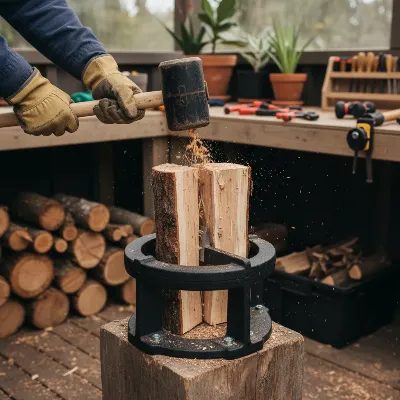 A person demonstrating safe use of the Kindling Cracker firewood splitter with a hammer on a log.
Using and Maintaining Your Kindling Cracker Safely
Even the simplest tools require proper technique and care to ensure longevity and user safety. The Kindling Cracker is no exception.
Safety When Using Your Kindling Cracker
The Kindling Cracker is designed with safety as its paramount feature, significantly reducing the risks associated with splitting wood. However, adhering to best practices is still crucial.
- Wear Personal Protective Equipment (PPE): Always use safety glasses to protect your eyes from wood splinters. Gloves can also provide a better grip and protect your hands from abrasions.
- Ensure a Stable Base: Mount your Kindling Cracker securely to a sturdy chopping block or stand using the pre-drilled bolt holes. This prevents the splitter from moving during use and enhances stability.
- Proper Wood Placement: Place the log vertically inside the safety ring, ensuring it rests on the splitting wedge. Give it a light tap so it stands unsupported before removing your hands.
- Use the Right Striking Tool: A 3-4 lb sledgehammer or a heavy mallet is recommended for striking the top of the wood. Never strike the blade itself, as this can cause damage.
- Maintain Awareness: Keep your fingers and thumb clear of the area where the hammer will strike. The safety ring is designed to keep your hands away from the blade, but vigilance is still key.
- Avoid Overloading: Do not attempt to split logs larger than the maximum diameter specified for your Kindling Cracker model (6.5 inches for the Original, 9 inches for the King). Forcing oversized wood can cause it to jam or damage the unit.
Routine Maintenance for Your Kindling Cracker
One of the Kindling Cracker’s greatest advantages is its minimal maintenance requirements, thanks to its robust cast-iron construction.
- Clean After Use: After each splitting session, brush off any wood debris, dust, or sap from the splitter. This prevents buildup and keeps the tool looking good.
- Blade Sharpening (If Desired): The unique wedge design means the blade doesn’t need to be razor-sharp to function effectively. However, if you notice performance decreasing, a few strokes with a metal file can easily refresh the edge. Some users also apply a thin coat of beeswax to the blade for protection.
- Check for Wear: Periodically inspect the cast iron for any signs of wear or damage. Though rare due to its durability, addressing any issues early can prolong its life.
- Storage: Store your Kindling Cracker in a dry, covered area to protect it from the elements. While it’s built tough, prolonged exposure to moisture can lead to rust. If left outside, occasional touch-ups with paint can help maintain its appearance.
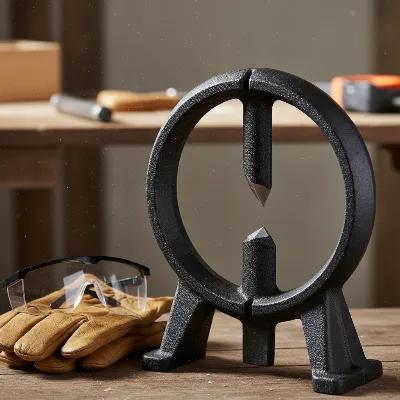 A close-up of the Kindling Cracker's cast iron body and safety ring, with safety glasses and gloves nearby.
Where to Buy the Kindling Cracker Firewood Splitter
The Kindling Cracker Firewood Splitter is widely available through various reputable retailers, ensuring you can find an authentic product that meets your needs.
You can typically find the Kindling Cracker through major online retailers, where it often has thousands of positive reviews highlighting its effectiveness and safety. Additionally, many outdoor and homesteading supply stores, both online and brick-and-mortar, carry the Kindling Cracker. When purchasing, ensure you are buying from an authorized dealer to guarantee product authenticity and warranty support. Always compare prices across different retailers, but prioritize trusted sources. While the Kindling Cracker is a robust tool, be wary of unusually low prices from unknown sellers, which might indicate a counterfeit product.
Conclusion
For anyone who burns wood for heat, cooking, or ambiance, the Kindling Cracker Firewood Splitter is a truly transformative tool. It brings unparalleled safety and efficiency to the often-risky task of preparing kindling, making it accessible and enjoyable for nearly everyone. Its robust, cast-iron construction ensures it’s a tool that will serve your household for many years, demanding minimal maintenance while consistently delivering perfectly split kindling. By investing in a Kindling Cracker, you’re not just buying a splitter; you’re investing in a safer, simpler, and more satisfying wood-splitting experience.
Are you ready to make kindling a breeze and embrace a safer way to prepare your firewood?
Frequently Asked Questions
What is the maximum size log the Kindling Cracker can split?
The Kindling Cracker comes in two main sizes: the Original, which can split logs up to 6.5 inches in diameter, and the Kindling Cracker King, designed for larger logs up to 9 inches in diameter. Both models are optimized for length, typically accommodating standard firewood lengths without issue.
Is the Kindling Cracker suitable for splitting all types of wood?
The Kindling Cracker performs exceptionally well with dry, seasoned wood, including common hardwoods like oak and softwoods such as pine and birch. While it can handle some hardwoods, very wet, green, or extremely knotty wood might be more challenging and require more force.
Does the Kindling Cracker come with a hammer or mallet?
No, the Kindling Cracker Firewood Splitter does not typically include a hammer or mallet. You will need to provide your own blunt instrument for striking the wood. A 3-4 pound sledgehammer or a heavy mallet is generally recommended for optimal performance.
How often does the Kindling Cracker’s blade need sharpening?
Due to its unique wedge design, the Kindling Cracker’s blade does not need to be razor-sharp to function effectively. It is virtually maintenance-free. If you notice a significant decrease in splitting performance after extensive use, a few strokes with a metal file can easily refresh the edge.
Can the Kindling Cracker be used indoors?
Yes, the Kindling Cracker can be used both indoors and outdoors. Since it operates manually and produces no fumes or excessive noise, it is safe to use in a garage, shed, or even near a fireplace hearth, provided it is securely mounted on a stable surface.
