Are you tired of the back-breaking labor of splitting firewood by hand, or perhaps your current log splitter just isn’t keeping up with the demands of your property? For tractor owners, a 3-point hitch log splitter offers a powerful, efficient, and mobile solution to transform daunting piles of logs into usable firewood. These versatile attachments leverage your tractor’s existing hydraulic system, turning a single piece of equipment into a robust wood-splitting powerhouse.
Choosing the right 3-point hitch log splitter can significantly streamline your firewood production, saving you time and physical effort. This comprehensive guide will examine what these machines are, how they work, the different types available, key factors to consider when buying one, and showcase some of the top models on the market today. Whether you’re managing a small homestead or tackling commercial-scale timber, understanding the nuances of these impressive tools is essential for making an informed decision that will serve you efficiently for years to come.
What is a Log Splitter? An Overview of the Equipment
A log splitter is a machine designed to split logs into smaller pieces, typically for firewood, rather than cutting them. It achieves this by forcing a log against a stationary wedge or by driving a wedge through a log, using hydraulic pressure to generate immense force. This process makes the arduous task of splitting wood, which traditionally required an axe and considerable manual labor, significantly faster, safer, and less physically demanding.
The evolution of log splitters has seen them transform from simple manual tools to sophisticated, powered machinery. Early versions were often rudimentary, relying on mechanical advantage to increase splitting force. Over time, the introduction of hydraulic systems revolutionized their capabilities, allowing for the creation of powerful machines capable of splitting even large, tough logs with ease. Today, log splitters come in various forms, catering to different power sources, sizes, and operational needs.
Modern log splitters are broadly categorized by their power source: electric, gas-powered, and tractor-powered. Electric models are typically smaller and best suited for light to medium-duty tasks around the home. Gas-powered splitters offer more power and portability for heavier use and larger logs, independent of a tractor. Tractor-powered log splitters, particularly those with a 3-point hitch system, are designed to utilize the power and hydraulic capabilities of an existing tractor, offering a highly efficient and mobile solution for significant wood splitting tasks.
Detailed Classification of Log Splitters
Log splitters are diverse, categorized primarily by their power source, size, capacity, and splitting orientation. Understanding these classifications is crucial for selecting a model that perfectly matches your specific requirements.
By Power Source
|
Our Picks for the Best Log Splitter in 2026
As an Amazon Associate I earn from qualifying purchases.
|
||
| Num | Product | Action |
|---|---|---|
| 1 | 13.8 Inch XL Manual Log Splitter with Self-Locking V-Blade for Hands-Free Safety - Unbreakable Welded Steel Firewood Cutter - Rust-Proof Electroplated Finish for Large Rounds, Fireplace & Camping |

|
| 2 | KABIN Kindle Quick Compact Log Splitter - Manual Splitting Tool - Steel Wedge Point Splits Firewood Like A Boss Safely & Easily |
|
| 3 | Kindling Cracker King XL Firewood Kindling Splitter – Extra-Large Cast Iron Wood Splitting Wedge, 9" Safety Ring, 17" Height, No Axe Needed, Made in Australia |
|
| 4 | 2 Pcs 4 Lbs Wood Splitting Wedges Manual Log Splitter Wedge 4-Direction Diamond Design Forged Steel Tool for Easy Wood Splitting Splits Firewood into 4 Pieces Less Effort (Orange) |
|
| 5 | Wood Kindling Splitter - The Firewood Kindling Tool for Wood Stove Fireplace and Fire Pit |
|
| 6 | Firewood Kindling Splitter for Wood, Heavy Duty Cast Iron Wood Splitters for Firewood with No Axe, Manual Log Splitter for Kindling Wedge Point with Safety Cover |
|
| 7 | ESTWING Sure Split Wedge - 5-Pound Wood Splitting Tool with Forged Steel Construction & 1-7/8" Cutting Edge - E-5 |
|
| 8 | Firewood Kindling Splitter, Manual Log Splitter, Cast Iron Log Splitting Wedge, Heavy Duty Wood Splitter Tool with Cover (Black) |
|
| 9 | Wall Mounted Wood Splitter: Dual-Handle Manual Kindling Splitter with 6-Tooth Clamping, Heavy Duty Steel Log Splitter for Soft Firewood, Includes Gloves and Screws for Indoor and Outdoor Use |
|
| 10 | Kindling Cracker Firewood Kindling Splitter — Original Cast Iron Wood Splitting Wedge, 6.5" Safety Ring, 12" Frame, No Axe Needed, New Zealand Designed & Australian Made |
|
The method a log splitter uses to generate its splitting force is a primary differentiator, influencing its power, portability, and operational characteristics.
Electric Log Splitters
Electric log splitters are typically the smallest and most environmentally friendly option, powered by an electric motor.
- Advantages: They are quiet, produce no emissions, require less maintenance than gas models, and are generally easier to start and operate. Their compact size makes them ideal for residential use or small-scale splitting in garages or workshops where electricity is readily available.
- Disadvantages: Their power is limited, making them suitable only for smaller, softer logs. They are restricted by the length of their power cord, limiting mobility.
- Applications: Perfect for homeowners with occasional firewood needs, splitting seasoned softwoods, or managing small quantities of kindling.
Gas Log Splitters
Gas-powered log splitters use a gasoline engine to drive a hydraulic pump, offering significant power and complete portability.
- Advantages: They are powerful, capable of splitting large, dense, and unseasoned logs. Their independence from an external power source means they can be used anywhere, making them ideal for remote splitting sites.
- Disadvantages: They are louder, produce exhaust fumes, and require more maintenance (oil changes, spark plug checks, fuel system care) than electric models. Initial cost and fuel expenses are also factors.
- Applications: Suited for heavy-duty residential use, commercial operations, or anyone needing to split large volumes of tough wood in various locations.
Hydraulic Log Splitters (Tractor-Powered)
These splitters, including 3-point hitch and PTO (Power Take-Off) models, harness the hydraulic system or engine power of a tractor.
- Advantages: They leverage existing farm equipment, eliminating the need for a separate engine, which can reduce initial cost and maintenance of the splitter itself. They offer substantial splitting power, are highly mobile when attached to a tractor, and can often be operated in various orientations.
- Disadvantages: Requires a tractor with adequate hydraulic flow (GPM) and pressure (PSI) for efficient operation. Can tie up the tractor for extended periods. PTO models might have a higher initial cost due to an additional hydraulic pump.
- Applications: Ideal for individuals with a tractor who need a powerful, mobile solution for processing significant amounts of firewood on large properties or farms.
Manual Log Splitters
Manual splitters rely solely on human effort, typically using a lever or a foot-operated pump to generate force.
- Advantages: Inexpensive, quiet, no emissions, and very little maintenance. They are good for light use or as a backup.
- Disadvantages: Labor-intensive, slow, and suitable only for small, easily split logs.
- Applications: For very infrequent use, small logs, or those who prefer a physical workout while preparing firewood.
By Size and Capacity
Log splitters also vary greatly in their physical dimensions and the amount of force they can exert, which directly correlates to the size and type of logs they can handle.
Small-Sized Log Splitters (Home Use)
These are typically electric or smaller gas models designed for light to medium tasks.
- Advantages: Easy to use, generally more affordable, and compact for easier storage. They are perfect for homeowners with moderate firewood needs.
- Disadvantages: Limited in power and throat capacity, meaning they cannot efficiently split very large or dense logs.
- Ideal for: Splitting seasoned logs up to 18-20 inches in length and 10-12 inches in diameter, suitable for home fireplaces or small wood stoves.
Large-Sized Log Splitters (Industrial Use)
These are usually powerful gas-powered or tractor-powered hydraulic units.
- Advantages: Exceptional power output, capable of handling very large, tough, and unseasoned logs. Built for continuous, heavy-duty operation.
- Disadvantages: High initial cost, large and cumbersome, requiring ample storage space and often a dedicated towing vehicle or tractor for transport.
- Ideal for: Commercial logging operations, large farms, or individuals who process many cords of wood annually, including hardwoods and oversized timber.
By Splitting Orientation
Log splitters can also be classified by how the log is positioned and split.
Horizontal Log Splitters
In this configuration, logs are placed horizontally on a beam and pushed into a wedge. This is common for many electric and smaller gas models.
Vertical Log Splitters
Logs are positioned vertically, often on the ground, and a wedge descends to split them. This is particularly useful for very large or heavy logs that are difficult to lift onto a horizontal beam.
Horizontal/Vertical Log Splitters
Many modern gas and tractor-powered splitters offer both horizontal and vertical splitting capabilities. The beam can be adjusted between positions, providing versatility for handling logs of various sizes and weights. This dual orientation maximizes efficiency, allowing users to split smaller logs horizontally for speed and larger logs vertically for ease of loading.
Comparison Table of Common Log Splitter Types
This table provides a concise overview of the key characteristics, advantages, and disadvantages of the most common log splitter types, aiding in your decision-making process.
| Feature | Electric Log Splitter | Gas Log Splitter | 3-Point Hitch Log Splitter (Tractor-Powered) | Manual Log Splitter |
|---|---|---|---|---|
| Power Source | Electric Motor (120V/240V) | Gasoline Engine | Tractor’s Hydraulic System | Human Effort |
| Power/Tonnage | 4-10 Tons | 20-40+ Tons | 10-35+ Tons (tractor dependent) | 2-5 Tons (effective) |
| Portability | Limited (cord-dependent) | High (self-contained) | High (tractor-dependent) | High (lightweight) |
| Initial Cost | Low | Medium to High | Medium (no separate engine) | Very Low |
| Maintenance | Low (no engine) | High (engine, fuel system, oil) | Low (splitter unit), High (tractor) | Very Low |
| Noise Level | Low | High | Medium (tractor engine) | Very Low |
| Emissions | None | High (exhaust) | High (tractor exhaust) | None |
| Ideal Use | Light residential, small logs | Heavy residential, commercial, large logs | Large properties, farms, various log sizes | Very light use, small logs, backup |
| Pros | Quiet, clean, easy to start | Powerful, highly mobile | Utilizes existing equipment, powerful, mobile | Inexpensive, quiet, no emissions |
| Cons | Limited power & mobility | Loud, emissions, more maintenance | Requires suitable tractor, ties up tractor | Labor-intensive, slow |
How to Choose the Right Log Splitter for Your Needs
Selecting the ideal log splitter, especially a 3-point hitch model, involves a careful assessment of your specific requirements and the capabilities of your tractor.
Determine Your Usage Needs
Before diving into specifications, consider the scope of your log splitting tasks.
- Volume of Wood: How much wood do you typically split in a season or year? If it’s just a few cords for a home fireplace, a smaller tonnage 3-point splitter might suffice. For continuous, high-volume processing for heating or sale, you’ll need a more robust and faster machine.
- Log Size and Type: What are the typical diameter and length of the logs you encounter? Are they mostly seasoned softwoods (like pine or cedar) which split easily, or are you dealing with tough, green hardwoods (like oak or hickory) with knots, which demand significantly more force? Larger and harder logs will necessitate higher tonnage.
- Budget: Establish a realistic budget that includes not only the purchase price of the splitter but also any necessary hydraulic hoses, quick connects, and potential maintenance.
Key Factors to Consider
Once you understand your needs, evaluate these critical technical aspects for a 3-point hitch log splitter.
-
Tractor Compatibility: This is paramount for 3-point hitch splitters.
- Horsepower (HP): While 3-point splitters don’t typically run off PTO directly, your tractor’s overall power indicates its capability to handle the attachment and its hydraulic system’s robustness.
- Hydraulic Flow Rate (GPM): The gallons per minute (GPM) your tractor’s hydraulic pump can deliver directly impacts the splitter’s cycle speed. A minimum of 4 GPM is often recommended, but 5-10 GPM or higher will ensure a much faster and more efficient operation. Insufficient GPM will result in a frustratingly slow cycle time.
- Hydraulic Pressure (PSI): The pounds per square inch (PSI) determines the maximum splitting force (tonnage) the splitter can achieve. Ensure your tractor’s hydraulic system can provide enough pressure (e.g., 2000-3700 PSI for a 16-ton splitter) to reach the desired tonnage.
- 3-Point Hitch Category: Most 3-point splitters are compatible with Category 1 or Category 2 hitches, but always verify for a proper fit.
-
Splitting Force (Tonnage): This is the measure of how much power the splitter can exert.
- Understanding Tonnage: It indicates the maximum resistance the splitter can overcome. For splitting soft, straight-grain, or dry wood, 22-28 tons is often sufficient. For tough, green hardwoods with knots, 30 tons or more is recommended.
- Matching to Wood: Always choose a tonnage that can handle the hardest, largest logs you expect to split. It’s better to have more power than less.
-
Log Capacity (Length and Diameter): Check the maximum log length and diameter the splitter can accommodate. Common splitting lengths range from 20 to 25 inches, suitable for most firewood applications.
-
Cycle Time: This refers to how quickly the ram extends and retracts to complete a split. A faster cycle time (e.g., 6-11 seconds for some 16-ton models) directly translates to higher productivity. Dual-action splitters can significantly reduce effective cycle time by splitting in both directions.
-
Orientation (Horizontal, Vertical, H/V): Decide if you prefer splitting horizontally (easier for smaller, lighter logs), vertically (ideal for large, heavy logs that are difficult to lift), or if a versatile horizontal/vertical model is best. Many 3-point splitters offer H/V capability or can be adjusted in height by the tractor’s hitch for easier loading.
-
Safety Features: Prioritize models with safety guards, two-hand operation requirements, automatic ram return, and secure log cradles to protect the operator.
-
Build Quality and Brand Reputation: Invest in a splitter from a reputable brand known for durable construction, quality components, and good customer support. This ensures longevity and reliable performance.
Evaluate Additional Features
Modern log splitters often come with features that enhance convenience, efficiency, and safety.
- Dual-Action Splitting: As seen in models like the Boss Industrial 16 Ton, these splitters apply force in both directions (forward and reverse), effectively doubling your splitting speed and efficiency.
- Automatic Return Detent: This feature allows the operator to release the control lever after a split, and the ram automatically retracts, freeing up a hand for the next log.
- 4-Way Wedge: An optional accessory for some models, a 4-way wedge splits a log into four pieces in a single pass, drastically speeding up production for uniform firewood.
- Log Cradles/Catch Trays: These help hold logs in place during splitting and catch split pieces, reducing bending and making the process smoother. The RuggedSplit 322-24-TR, for instance, offers an optional catcher tray to improve workflow.
- Transportability: While 3-point hitch splitters are inherently portable with a tractor, some may include a trailer hitch for additional towing flexibility when detached.
Top 5 Best 3-Point Hitch Log Splitters for Tractors (2026)
Selecting the best 3-point hitch log splitters involves looking at a combination of power, durability, features, and overall value. Here are five top contenders that stand out for their performance and reliability, designed to work seamlessly with your tractor.
1. Boss Industrial 16 Ton 3-Point Hitch Log Splitter (Model 3PT16T21)
This Boss Industrial model is an excellent choice for landowners seeking a robust and efficient splitter for medium-duty tasks. It’s renowned for its dual-action splitting capability, which means the wedge splits logs on both the forward and reverse strokes, significantly cutting down cycle times.
- Key Features: Dual-action splitting (up to 3-4 cycles per split), horizontal/vertical operation, up to 16 tons of splitting force (tractor-dependent, with a maximum potential of 13 tons), max splitting length of 20.5 inches.
- Tractor Requirements: Recommended hydraulic flow of 5-10 GPM and 2000-3700 PSI.
- Pros: Very fast splitting, versatile H/V operation, comes with a 2-year residential warranty. Includes a trailer hitch for easy transport.
- Cons: Tonnage can vary depending on tractor’s hydraulic output, might be less powerful for extremely large, knotty hardwoods compared to higher-tonnage units.
- Ideal for: Homeowners and small farms needing a quick, efficient splitter for regular firewood production from various wood types.
2. Boss Industrial 22 Ton H/V 3-Point Hitch Log Splitter
Stepping up in power, the 22-ton H/V model from Boss Industrial offers increased force for tackling larger and tougher logs. It builds on the strengths of the 16-ton model, providing the extra muscle needed for demanding splitting jobs.
- Key Features: Higher splitting force (22 tons), horizontal/vertical functionality, dual-action splitting.
- Tractor Requirements: Requires a tractor with suitable hydraulic flow and pressure to achieve full tonnage.
- Pros: Enhanced power for harder and larger logs, still benefits from dual-action efficiency and H/V versatility.
- Cons: Heavier and potentially more expensive than the 16-ton model; demands a tractor with a robust hydraulic system.
- Ideal for: Those who frequently encounter larger diameter logs or tougher hardwoods and require a significant boost in splitting power.
3. RuggedSplit 322-24-TR 3-Point Hitch Tractor Mount Log Splitter
The RuggedSplit 322-24-TR is a well-regarded 3-point hitch splitter, known for its practical design and robust construction. It’s often highlighted for its “push-through” horizontal splitting action, which can be adjusted in height using the tractor’s 3-point hitch.
- Key Features: 22-ton splitting force, horizontal “push-through” design (can be set low for heavy logs), compatible with Category 1 or 2 hitches, includes a valve with a return detent.
- Tractor Requirements: Utilizes tractor hydraulics; specific GPM/PSI recommendations would be in the manual but typically aligns with standard tractor outputs.
- Pros: Durable build, versatile height adjustment via tractor hitch, optional catcher tray enhances workflow by keeping split wood contained, reducing bending.
- Cons: Primarily horizontal splitting (though height adjustable), may not offer the true vertical splitting convenience of some H/V models.
- Ideal for: Users who appreciate a sturdy, efficient horizontal splitter and value the convenience of an optional log catcher and detent return.
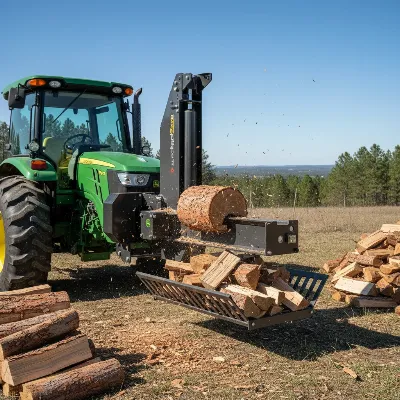 RuggedSplit 322-24-TR 3-point hitch log splitter attached to a tractor, splitting a large log horizontally with a catcher tray installed.
4. Split-Fire 3403 3-Point Log Splitter
Split-Fire is a brand recognized for producing high-quality, durable log splitters, and the 3403 model is no exception. This 3-point splitter is often praised for its robust build and reliable performance in demanding conditions.
- Key Features: Known for heavy-duty construction, efficient splitting, and often featuring a unique two-way splitting action. Specific tonnage varies by configuration but is designed for serious work.
- Tractor Requirements: Connects to standard 3-point hitches and uses tractor hydraulics; performance is dependent on tractor’s GPM/PSI.
- Pros: Exceptional durability and build quality, efficient two-way splitting design often allows for faster operation, excellent reputation in the industry.
- Cons: Typically a premium product, which may come with a higher price point; specific features and tonnage need verification based on current model year.
- Ideal for: Professional users, large property owners, or anyone seeking a top-tier, long-lasting 3-point splitter that can handle continuous heavy use.
5. High-Tonnage Professional 3-Point Splitter (e.g., 30+ Ton Category)
For those with commercial-scale operations or consistently handling very large, dense, and challenging logs, a high-tonnage professional 3-point splitter is the ultimate solution. While specific model names can vary widely by manufacturer and region (e.g., some larger Tool Tuff units, or specialized fabricator models), the focus is on raw power and robust construction.
- Key Features: 30+ tons of splitting force, often featuring reinforced beams, larger hydraulic cylinders, and commercial-grade components for sustained heavy use. May incorporate dual-action or specialized wedge designs for efficiency.
- Tractor Requirements: Demands a powerful tractor with a high hydraulic flow rate (e.g., 15-20+ GPM) and high PSI to operate effectively and prevent slow cycle times. Often Category 2 or 3 hitch compatible.
- Pros: Unmatched power for the toughest logs, designed for continuous professional use, highly durable.
- Cons: Requires a very powerful and capable tractor, higher initial investment, heavier and more challenging to maneuver due to size.
- Ideal for: Logging contractors, very large farms, or users who require the absolute maximum splitting power and durability from a tractor-mounted unit.
Safe Operation and Maintenance of Your Log Splitter
Operating and maintaining your 3-point hitch log splitter safely and correctly is essential for both your well-being and the longevity of the equipment.
Safety While Operating
Log splitters are powerful machines that demand respect and adherence to safety protocols.
- Personal Protective Equipment (PPE): Always wear safety glasses or a face shield to protect against flying debris. Heavy-duty gloves protect hands from splinters and impacts. Steel-toed boots are crucial for foot protection, and hearing protection is recommended, especially when the tractor engine is running.
- Pre-Operation Checklist: Before each use, thoroughly inspect your log splitter and tractor. Check all hydraulic lines for leaks, ensuring connections are secure. Verify that all bolts and pins are tight, particularly those connecting the splitter to the 3-point hitch. Ensure the splitting wedge and ram are clear of obstructions.
- Follow Manufacturer Instructions: Always read and understand the operator’s manual for both your log splitter and your tractor. Pay close attention to recommended operating procedures, safety warnings, and maintenance schedules.
- Maintain a Safe Work Area: Keep bystanders, especially children and pets, at a safe distance from the operating area. Ensure the ground around the splitter is level and clear of tripping hazards. Never operate the splitter alone in isolated areas.
- Proper Log Handling: Never place hands or feet near the splitting wedge or ram while the machine is in operation. Use both hands on the control lever if required, or ensure one-hand operation allows for a safe distance. Do not attempt to split logs that are too large for the machine’s capacity.
> “Safety is not an accessory; it’s a fundamental component of every log splitting session. Always assume the unexpected and prepare accordingly.”
Routine Maintenance
Regular maintenance will keep your log splitter in peak condition and extend its operational life.
- Post-Use Cleaning: After each splitting session, clean the splitter thoroughly. Remove wood chips, sawdust, and debris from the ram, wedge, and beam. This prevents buildup that could impede operation or hide potential issues.
- Hydraulic System Care: As 3-point hitch splitters rely on your tractor’s hydraulics, regular checks of the tractor’s hydraulic fluid level and condition are vital. Follow your tractor manufacturer’s recommendations for fluid type and change intervals. Inspect hydraulic hoses for wear, cracks, or leaks, and replace damaged hoses immediately.
- Lubrication: Lubricate all moving parts, such as the ram slide plates or wedge guides, according to the manufacturer’s instructions. Proper lubrication reduces friction and wear.
- Bolt and Fastener Checks: Periodically check and tighten all nuts, bolts, and fasteners, as vibrations during operation can loosen them over time.
- Storage: When not in use, store your log splitter in a dry, covered area to protect it from the elements. This prevents rust and corrosion.
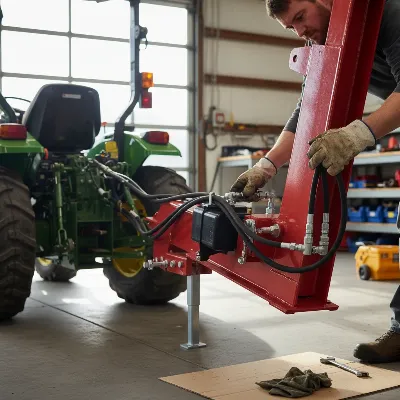 A person wearing work gloves inspects the hydraulic lines of a 3-point hitch log splitter attached to a tractor in a workshop setting.
Where to Buy a Reliable 3-Point Hitch Log Splitter?
When investing in a 3-point hitch log splitter, it’s important to purchase from reputable sources to ensure you get a quality product with proper support.
- Authorized Dealerships: Visiting local agricultural equipment dealers (for brands like John Deere, Kubota, Massey Ferguson, etc.) or specialty power equipment stores is often the best option. They typically carry a range of 3-point hitch attachments, can offer expert advice on compatibility with your specific tractor, and provide warranty support and servicing.
- Online Retailers: Major online agricultural and outdoor equipment retailers (e.g., Northern Tool + Equipment, Tractor Supply Co., Agri-Supply) often have a wide selection of 3-point hitch log splitters from various brands. Be sure to check product specifications, customer reviews, and shipping policies carefully.
- Manufacturer Websites: Buying directly from the manufacturer’s website (e.g., Boss Industrial, RuggedMade, Split-Fire) can ensure you get genuine products and direct access to product information and customer service.
- Used Market Considerations: While buying a used 3-point log splitter can save money, proceed with caution. Thoroughly inspect the unit for hydraulic leaks, structural damage, ram play, and overall wear. If possible, test the unit on a tractor to assess its cycle speed and splitting power. Inquire about its maintenance history.
Conclusion
A 3-point hitch log splitter is an invaluable investment for any tractor owner looking to efficiently process firewood. By leveraging your tractor’s power and hydraulic system, these attachments offer robust performance, enhanced mobility, and significant time and labor savings compared to traditional splitting methods. From understanding the crucial role of your tractor’s hydraulic flow to selecting features like dual-action splitting and appropriate tonnage, making an informed decision is key to maximizing your productivity.
When choosing your ideal log splitter, to prioritize safety, match the splitter’s capabilities to your tractor and your wood-splitting needs, and commit to regular maintenance. Whether you opt for a versatile 16-ton Boss Industrial, a durable RuggedSplit, or a high-tonnage professional model, the right 3-point hitch log splitter will improve your firewood preparation. What kind of wood-splitting challenges are you hoping to conquer with your next log splitter?
Frequently Asked Questions
What is the minimum GPM a tractor needs for a 3-point hitch log splitter?
While some entry-level 3-point log splitters might function with as low as 4 GPM, a flow rate of 5-10 GPM is generally recommended for efficient and reasonably fast operation. Higher GPM will result in quicker cycle times, significantly improving productivity.
Can a 3-point hitch log splitter damage my tractor?
Yes, an improperly matched or poorly maintained 3-point log splitter can potentially damage your tractor. If the splitter demands more hydraulic flow or pressure than your tractor can safely provide, it can strain the tractor’s hydraulic
Get our weekly buyer guide
Practical specs, not advice. Unsubscribe anytime.
