For homeowners and seasoned wood splitters alike, the task of processing firewood often brings unique challenges. Among the many types of wood, elm stands out as particularly notorious for its stringy, interlocking grain, posing a significant hurdle even for powerful machinery. When you add high moisture content, commonly known as “wet” or “green” wood, the question of whether an electric log splitter can handle the job becomes even more pressing. This article delves into the feasibility, techniques, and precautions involved in tackling wet elm with an electric splitter, providing practical advice to make your wood-splitting endeavors safer and more efficient.
Understanding Elm Wood: The “Stringy” Challenge
Elm wood presents a distinct challenge to anyone attempting to split it. Its most defining characteristic is its “interlocking grain,” which means the wood fibers do not run straight along the log but twist and intertwine. This makes it incredibly resistant to splitting, often leading to frustrating hang-ups and ragged breaks. Many experienced woodcutters consider elm a “nightmare” to split manually.
The moisture content of elm also plays a role. “Green” or wet elm, freshly cut, has a high water content, which can cause its fibers to swell. While some general advice suggests that wet wood is tougher due to increased density and resistance, other perspectives argue that the supple fibers of green wood can sometimes be easier to split than hardened, dry wood, depending on the species. However, dry or “seasoned” elm, especially if it was standing dead, can become even more notoriously difficult and stringy, making it a formidable opponent for any splitter. Interestingly, splitting elm in very cold, sub-freezing temperatures has been noted to make the process easier, as the expanding water within the wood can assist in breaking the fibers.
Electric Log Splitters: Capabilities and Limitations
Electric log splitters are popular choices for homeowners due to their convenience, lower noise levels, and emission-free operation, making them suitable for residential areas. These machines typically deliver splitting forces ranging from 5 to 10 tons and can handle logs up to approximately 9.8 to 12 inches in diameter and 20.4 to 20.5 inches in length. They simplify the task of preparing firewood, transforming what would be a laborious manual process into a more efficient one.
However, electric splitters come with inherent limitations, especially when pitted against demanding wood types like elm, particularly when wet. Their return cycle can be slower compared to their gas-powered counterparts. More critically, they may struggle with twisted, knotty sections, or very dense, green wood. An underpowered electric splitter can find splitting very green, wet wood “nearly impossible.” Logs can get stuck halfway or even fly off the splitter if the resistance is too great, and the motor might continue running even if the ram stops moving forward. While a powerful hydraulic splitter might “tear its way through” elm, it often won’t achieve a clean split due to the wood’s unique grain structure.
The Intersection: Splitting Wet Elm with an Electric Splitter
Attempting to split wet elm with an electric log splitter is a nuanced task. It is generally possible, but success largely depends on several factors, including the splitter’s tonnage, the specific characteristics of the elm logs, and the techniques employed.
The high moisture content in wet elm increases its density and the resistance of its fibers, demanding more power from the splitter. This means that an electric splitter on the lower end of the tonnage spectrum (e.g., 5-6 tons) will likely struggle more than a model with 7 tons or more of splitting force. Logs that are knotty, have highly twisted grain, or are particularly large in diameter will exacerbate the challenge. When the splitter encounters too much resistance, it may slow down, stall, or fail to complete the split, leading to frustration and potential wear on the machine. The notoriously stringy nature of elm, regardless of its moisture content, means that even successful splits may result in ragged edges and require additional effort to fully separate the pieces.
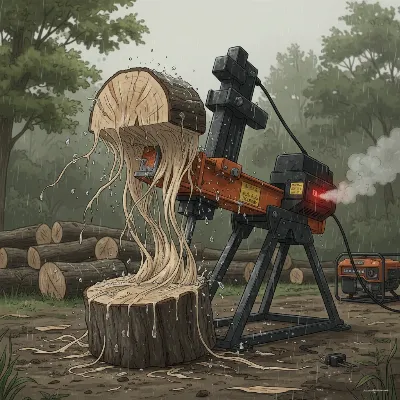 An electric log splitter struggling to split a round of wet elm wood, with stringy fibers resisting the wedge.
Expert Strategies for Splitting Wet Elm Effectively
To maximize your chances of success and minimize frustration when using an electric splitter on wet elm, strategic preparation and refined techniques are essential.
Pre-Splitting Preparation
- Assess Log Characteristics: Before placing a log on the splitter, take a moment to examine it. Look for areas with a straighter grain, as these will be significantly easier to split than sections with visible knots or highly twisted grain. Knots are the densest and most challenging parts of any log.
- Consider Moisture and Temperature: While wet wood is often denser, some argue that its “supple” fibers can sometimes make it more pliable for splitting compared to bone-dry, hardened wood. If you have the option, splitting green elm soon after felling can be advantageous. Alternatively, if conditions allow, splitting elm in sub-freezing temperatures can cause the water in the wood to expand, aiding the splitting process.
- Cut Shorter Rounds: For particularly stubborn or large elm logs, cutting them into shorter lengths than usual can reduce the amount of resistance the splitter faces along the grain, making the job more manageable.
|
Our Picks for the Best Log Splitter in 2026
As an Amazon Associate I earn from qualifying purchases.
|
||
| Num | Product | Action |
|---|---|---|
| 1 | 2 Pcs 4 Lbs Wood Splitting Wedges Manual Log Splitter Wedge 4-Direction Diamond Design Forged Steel Tool for Easy Wood Splitting Splits Firewood into 4 Pieces Less Effort (Orange) |

|
| 2 | Wood Kindling Splitter - The Firewood Kindling Tool for Wood Stove Fireplace and Fire Pit |
|
| 3 | Wall Mounted Wood Splitter: Dual-Handle Manual Kindling Splitter with 6-Tooth Clamping, Heavy Duty Steel Log Splitter for Soft Firewood, Includes Gloves and Screws for Indoor and Outdoor Use |
|
| 4 | Firewood Kindling Splitter for Wood, Heavy Duty Cast Iron Wood Splitters for Firewood with No Axe, Manual Log Splitter for Kindling Wedge Point with Safety Cover |
|
| 5 | ESTWING Sure Split Wedge - 5-Pound Wood Splitting Tool with Forged Steel Construction & 1-7/8" Cutting Edge - E-5 |
|
| 6 | KABIN Kindle Quick Compact Log Splitter - Manual Splitting Tool - Steel Wedge Point Splits Firewood Like A Boss Safely & Easily |
|
| 7 | Firewood Kindling Splitter, Manual Log Splitter, Cast Iron Log Splitting Wedge, Heavy Duty Wood Splitter Tool with Cover (Black) |
|
| 8 | 13.8 Inch XL Manual Log Splitter with Self-Locking V-Blade for Hands-Free Safety - Unbreakable Welded Steel Firewood Cutter - Rust-Proof Electroplated Finish for Large Rounds, Fireplace & Camping |
|
| 9 | Kindling Cracker Firewood Kindling Splitter — Original Cast Iron Wood Splitting Wedge, 6.5" Safety Ring, 12" Frame, No Axe Needed, New Zealand Designed & Australian Made |
|
| 10 | Kindling Cracker King XL Firewood Kindling Splitter – Extra-Large Cast Iron Wood Splitting Wedge, 9" Safety Ring, 17" Height, No Axe Needed, Made in Australia |
|
Optimized Splitting Techniques
- Off-Center Splitting: This is perhaps the most crucial technique for challenging wood like elm. Instead of attempting to split the log directly down the middle, position the log off-center. Aim to “peel” off smaller pieces from the edge first. The center of a log is its densest point, so attacking the perimeter often requires less force. You can gradually work your way around the log, paring it down until the core is small enough to split.
- Address Knots Strategically: If a log has knots, try to position them so they are pointing upward. This aligns the knot parallel to the splitting wedge, reducing the chance of the wedge getting jammed or damaged.
- Lubricate the Wedge: Applying a lubricating oil to the splitter’s wedge can help reduce friction as it pushes through the wood, allowing it to slide more easily and reducing the strain on the machine.
- Don’t Force It: If a log is exceptionally tough and the splitter stalls or struggles significantly, do not continue to force it. Repeatedly attempting to split a log that is too difficult can damage your machine. Instead, reposition the log, try a different technique, or consider setting it aside for a more powerful splitter. If the log gets stuck, a mallet can be used to carefully knock it off the wedge.
Equipment Considerations
- Adequate Tonnage: Ensure your electric splitter has sufficient splitting force. For elm, especially wet elm, a model with at least 6.5 to 7 tons of force is preferable, and higher tonnage is always better for challenging wood.
- Sharp Wedge: A dull wedge tries to plow through wood rather than cleanly splitting it, requiring more force and increasing strain. Regularly sharpen your splitter’s wedge for optimal performance.
- Power Source: Make sure your electric splitter is connected to a suitable power source with adequate amperage, ideally without an extension cord. If an extension cord is necessary, ensure it is properly rated to prevent voltage drop and circuit breaker trips.
Safety First: Protecting Yourself While Splitting
Operating any log splitter, especially with challenging wood, requires strict adherence to safety protocols. Log splitters generate thousands of pounds of pressure, making safety paramount.
- Personal Protective Equipment (PPE): Always wear sturdy gloves to protect your hands from splinters and impacts. Safety glasses or a face shield are crucial to protect your eyes from flying wood chips and debris. Steel-toe-capped boots are highly recommended to safeguard your feet from falling logs.
- Clear Work Area: Ensure your splitting area is clear of any obstructions, tripping hazards, pets, and children. Logs can sometimes fly off the splitter, so keep people and valuables away from the sides of the machine.
- Stable Setup: Position your log splitter on a flat, stable surface to prevent tipping or instability during operation.
- Two-Hand Operation: Many electric log splitters are designed with two-hand controls as a safety feature, requiring both hands to be engaged to operate the machine. This keeps your hands safely away from the moving ram and wedge. Always follow the manufacturer’s instructions.
When to Consider Alternatives or Professional Help
Despite employing the best techniques, there may be instances where an electric splitter simply isn’t powerful enough for certain wet elm logs. If your splitter consistently struggles, stalls, or shows signs of strain (like a slow-moving ram despite the motor running), it’s a clear indication that the log is beyond its capacity. Continuing to force the machine can lead to premature wear or damage to hydraulic components or the motor.
For very large logs, extremely knotty elm, or if you have a significant volume of difficult wood, consider renting a more powerful gas-powered or hydraulic log splitter, which typically offer higher tonnage and faster cycle times. Alternatively, professional firewood processors or arborists have heavy-duty equipment capable of handling the toughest wood, saving you time, effort, and potential damage to your home equipment.
Conclusion
Splitting wet elm wood with an electric log splitter is an achievable task, but it requires a combination of adequate equipment, strategic techniques, and an unwavering commitment to safety. While elm’s notorious interlocking grain and the added density of moisture present a formidable challenge, understanding the wood’s characteristics and applying methods like off-center splitting can significantly improve your success rate. Always prioritize safety with appropriate personal protective equipment and a clear workspace. Knowing when to persist and when to seek more powerful alternatives or professional help will ensure both your efficiency and the longevity of your equipment.
Ultimately, tackling wet elm with an electric splitter is a test of patience and skill. Are you ready to embrace the challenge and master the art of splitting this demanding wood?
Câu Hỏi Thường Gặp
Is wet elm harder to split than dry elm?
The difficulty of splitting elm wood is highly debated. While wet wood is generally denser, some experts find green elm’s supple fibers easier to split than dry, hardened elm. However, dry elm, especially standing dead, can become extremely stringy and difficult. Freezing temperatures can also aid in splitting either wet or dry elm by expanding moisture within the wood.
What tonnage electric splitter is best for elm?
For splitting elm, particularly wet elm, an electric log splitter with at least 6.5 to 7 tons of splitting force is recommended. Higher tonnage models, around 8-10 tons, will provide greater power and reduce the likelihood of stalling, especially when dealing with larger diameters, knots, or highly twisted grains characteristic of elm.
Can splitting wet wood damage my electric splitter?
Repeatedly trying to split very dense or knotty wet wood that exceeds your electric splitter’s capacity can put excessive strain on its motor and hydraulic system. This can lead to overheating, reduced performance, or premature wear of components like the hydraulic pump or ram seals. It’s crucial to avoid forcing the machine if it struggles significantly.
What are the best tips for splitting stringy wood?
When splitting stringy wood like elm, focus on off-center splitting, “peeling” smaller pieces from the log’s perimeter instead of aiming for the center. Keep any visible knots pointing upward to align them with the wedge. Cutting logs into shorter rounds can also reduce resistance. Additionally, lubricating the splitting wedge can help it glide through tough fibers more easily.
